
Anthrax.
Anthrax.
Ten years separate For All Kings from Cursum Perficio. Anthrax’s twelfth studio album lands on 18 September through Megaforce in the United States and Nuclear Blast in Europe, and it is the band’s first new record since 2016.
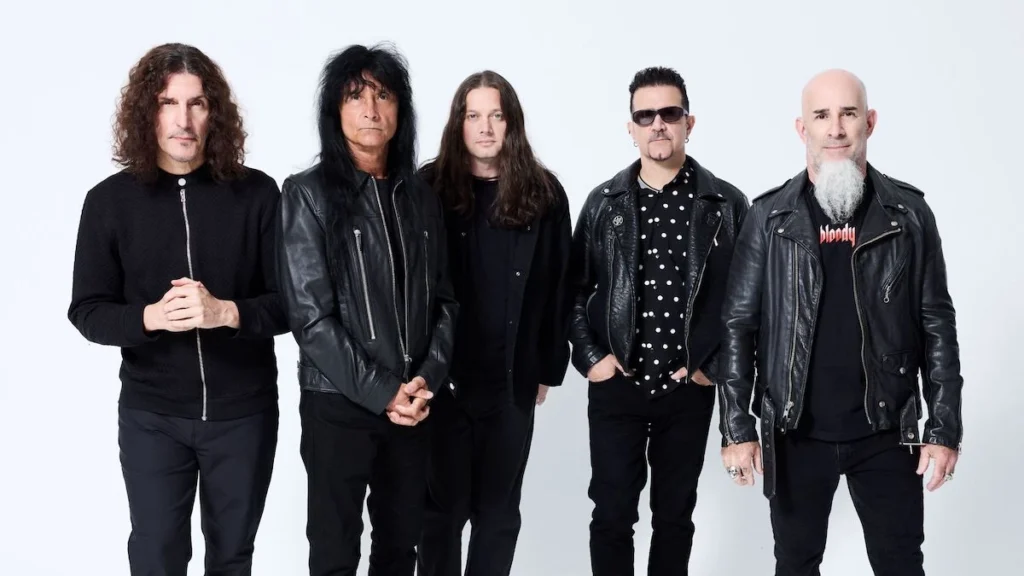
The lineup is unchanged across that gap: Scott Ian on guitar, Charlie Benante on drums, Frank Bello on bass, Joey Belladonna on vocals and Jonathan Donais on guitar. The previous album debuted inside the top ten of the Billboard 200, which is the mark this one is measured against.
Where the Ten Years Went
Recording began in earnest in 2022, at Studio 606 in Los Angeles, the room Dave Grohl built. That places roughly four years between the start of tracking and the release date, and six between the last album and the first session.
Long gaps in a catalogue usually indicate one of two things: a band that stopped, or a band that kept touring and did not write. Anthrax did the second. The consequence is an album assembled across a long window rather than in a single block, which tends to show up as variation in the material rather than as a single sound.
The single released alongside the announcement in May, “It’s For The Kids”, was the band’s first new song in a decade. Scott Ian has described it as a four-minute thrash track written deliberately to reach back to the band’s first era, and as a piece aimed squarely at the existing audience rather than a new one.
Gaps of this length are their own kind of release event, and the shape of the return matters more than the wait. The site has tracked where a band sits after a two-year gap before; ten is a different order of question, because the audience that has to be re-met has itself moved on.
The Title Came From a Marilyn Monroe Documentary
The Latin phrase translates as “My journey has come to an end”, or “I complete my journey”. Attached to a twelfth album after a decade away, it reads as a valediction, and the band have moved to correct that reading.
Charlie Benante explained where it came from. “I was watching a Marilyn Monroe documentary, and I saw ‘Cursum Perficio’ written on a tile in her last home,” he said. “When I found out what the phrase meant, it immediately clicked with me. We aren’t saying this is our last record, but our journey has come to an end. I believe we’ve completed the task.”
The distinction he draws is between a career ending and a piece of work being finished. Whether the audience reads it that way is a separate question, and the phrase will carry the retirement implication regardless of what the band say.
Eleven Tracks and a Video That Looks Backwards
The album runs eleven tracks: “Persistence Of Memory”, “The Long Goodbye”, “It’s For The Kids”, “Everybody’s Got A Plan”, “The Edge Of Perfection”, “Infectious”, “NYC93”, “Cursum Perficio”, “T.O.M.B”, “Watch It Go” and “My Victory”.
Two titles point directly at the band’s own history. “NYC93” names a year and a city, and Anthrax’s identity has always been a New York one. “The Long Goodbye” sits at track two, which is a placement rather than an accident on a record carrying this title.
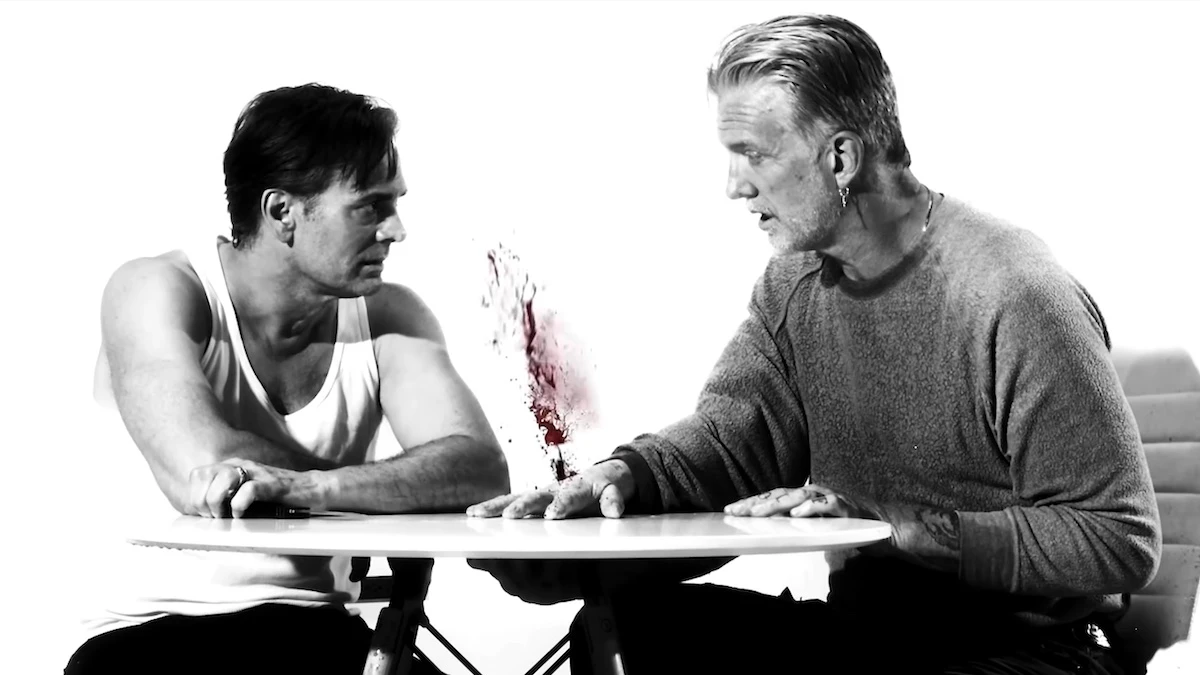
The video for the lead single recreates elements of the band’s clip for “Madhouse”, filmed in an asylum. That is a deliberate callback to the same first era Ian described, and it pairs Belladonna’s vocal with the heavier groove-metal elements the band picked up during the John Bush years.
Jay Ruston Stays in the Chair
Jay Ruston produced the record alongside the band, continuing a working relationship that runs back through the previous album. Retaining a producer across a ten-year gap is a stability decision, and it removes one variable from a return that already carries several.
Ruston’s habit is a clean, forward mix with the drums high and the guitars separated rather than stacked into a wall. On a thrash record that choice is audible immediately, because it either preserves the rhythm playing or buries it, and the single suggests it has been preserved.
Studio 606 supports that approach. It is a live room built for a band playing together, and it favours records tracked as performances rather than assembled part by part. For a group whose value is in the rhythm section locking, that is the correct address.
Nine Formats and a Zoetrope
The release schedule is unusually elaborate. Alongside a standard CD and a standard black double LP with a pop-up gatefold, there are retailer-specific pressings: a Target CD with a fabric patch, a Target red zoetrope double LP, an Amazon purple zoetrope, a merch-exclusive lilac pressing, a white vinyl edition through Metal Injection, a signed red-ripple edition through Talk Shop Live, and an indie-store red, orange and yellow pressing.
Zoetrope vinyl carries an image that animates under a strobe when the record spins, which makes it an object rather than a format. Nine variants is a strategy aimed at a collector base rather than a casual buyer, and it is a reasonable read of who buys a thrash album in its first week.
It also has a chart consequence. Physical variants concentrate sales into the opening week, which is where a top-ten placement is won or lost. Blabbermouth listed the full set of editions when the album was announced, and Nuclear Blast carried the European detail.
Where Anthrax Sit in the Catalogue Now
Twelve albums across four decades puts Anthrax in a small group. The band’s commercial peak sits in the late 1980s and early 1990s, and every record since has been measured against a period the current audience mostly did not attend. That comparison is unavoidable and it is also, by now, largely irrelevant to how the catalogue actually performs.
What has held is the live business. The band have toured consistently through the gap, which is the reason a ten-year absence from record shops did not translate into an absence from the circuit. For a thrash act, the tour is the primary channel and the album is what justifies the routing, which reverses the order most genres work in.
That order explains the release plan. A record aimed at a touring audience does not need radio, playlist placement or a crossover single. It needs a physical object the audience will queue for and four minutes of material that works at volume in front of a crowd, which is precisely what the lead single was written to be.
The lineup stability matters here too. Belladonna has now sung on the band’s records across three separate stretches, and the current five-piece has been intact long enough that the personnel question, which dominated coverage of the band for years, has stopped being the story. On a twelfth album that is worth something: the audience arriving on 18 September knows exactly which Anthrax it is getting.
What the Record Has to Clear
The benchmark is For All Kings, which opened in the top ten of the Billboard 200. Matching that a decade later, in a market where physical sales carry more of the opening week than they did, is a different exercise from matching it in 2016.
The band’s advantage is that thrash audiences hold. The genre’s core buyers stay with a catalogue for decades and turn out for a release rather than waiting for it to surface in a feed, which is exactly the behaviour a nine-format rollout is built to capture.
What it cannot do is manufacture a new audience, and the single is explicitly not trying to. Consequence’s report quotes Ian describing the track as a letter to the band’s fans. On 18 September the question is how many of those fans are still counting, and a ten-year gap is a long time to leave that unanswered.
About Author